Contractors Save Money with Local Landscape Suppliers
Key takeaway: Ohio contractors can reduce supply-run time, repeated handling, and avoidable project costs by ordering from a local landscape supplier. The biggest savings come from confirming materials before dispatching a truck, measuring quantities accurately, and choosing pickup or delivery based on the full job cost, not just the material price.
A supply run rarely takes only the time spent driving.
There’s the trip to the yard, loading, the return drive, and unloading. If two crew members go along, both are away from the job. And if the wrong material comes back, you've lost even more time.
For Ohio landscape contractors, those interruptions add up. Working with a reliable local landscape supplier can help keep crews on the job, materials on schedule, and unnecessary expenses under control. But getting the most out of that relationship takes a little planning.
Here are six ways to make your material orders more efficient and cost-effective.
1. Compare the Full Cost of Getting Materials to the Job
The lowest price per yard does not always produce the lowest project cost.
When comparing material sources, account for:
- Material price and applicable fees.
- Round-trip driving time.
- Loading and unloading time.
- Fuel and vehicle operating costs.
- The number of employees making the trip.
- Additional trips required by safe hauling limits.
A useful comparison is:
Self-hauling cost = materials + crew time + vehicle costs + handling time.
Delivered cost = materials + delivery fees + on-site receiving and handling time.
For example, suppose two employees spend approximately 90 minutes on a supply run. That represents approximately three labor-hours away from installation, even though only an hour and a half passed on the clock.
The practical question is not simply, “Which material costs less?” It is, “Which ordering option keeps this project moving at the lowest total cost?”
2. Confirm Availability Before Sending the Truck
Nothing wastes time quite like sending a truck to pick up materials that aren't available. A quick call to confirm inventory, product specifications, and pickup procedures can save your crew an unnecessary trip.
Before leaving the jobsite, confirm:
- The exact product name and specification.
- The quantity available at your chosen location.
- Whether the material is sold by volume, weight, bag, or pallet.
- Current pickup hours and loading procedures.
- Whether the order requires advance coordination.
For mulch installations, record the product and color the customer approved. For aggregate work, confirm the specified size and type rather than ordering “gravel” and hoping it matches the plan.
Kurtz Bros. offers landscape materials including mulch, topsoil, compost, gravel, limestone, sand, decorative stone, pavers, and wallstone. Confirming the specific product and location before dispatch helps reduce the risk of an unnecessary trip or an unapproved substitution.
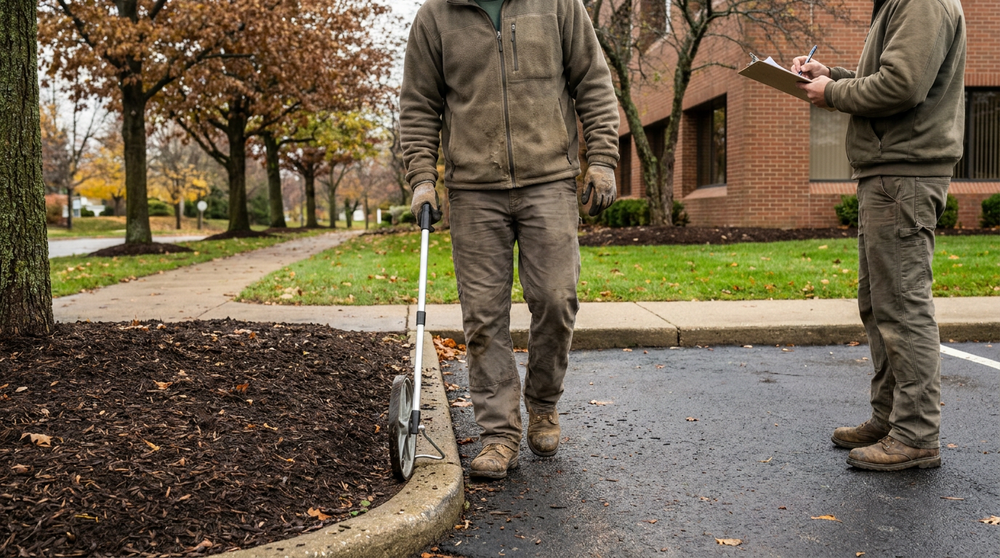
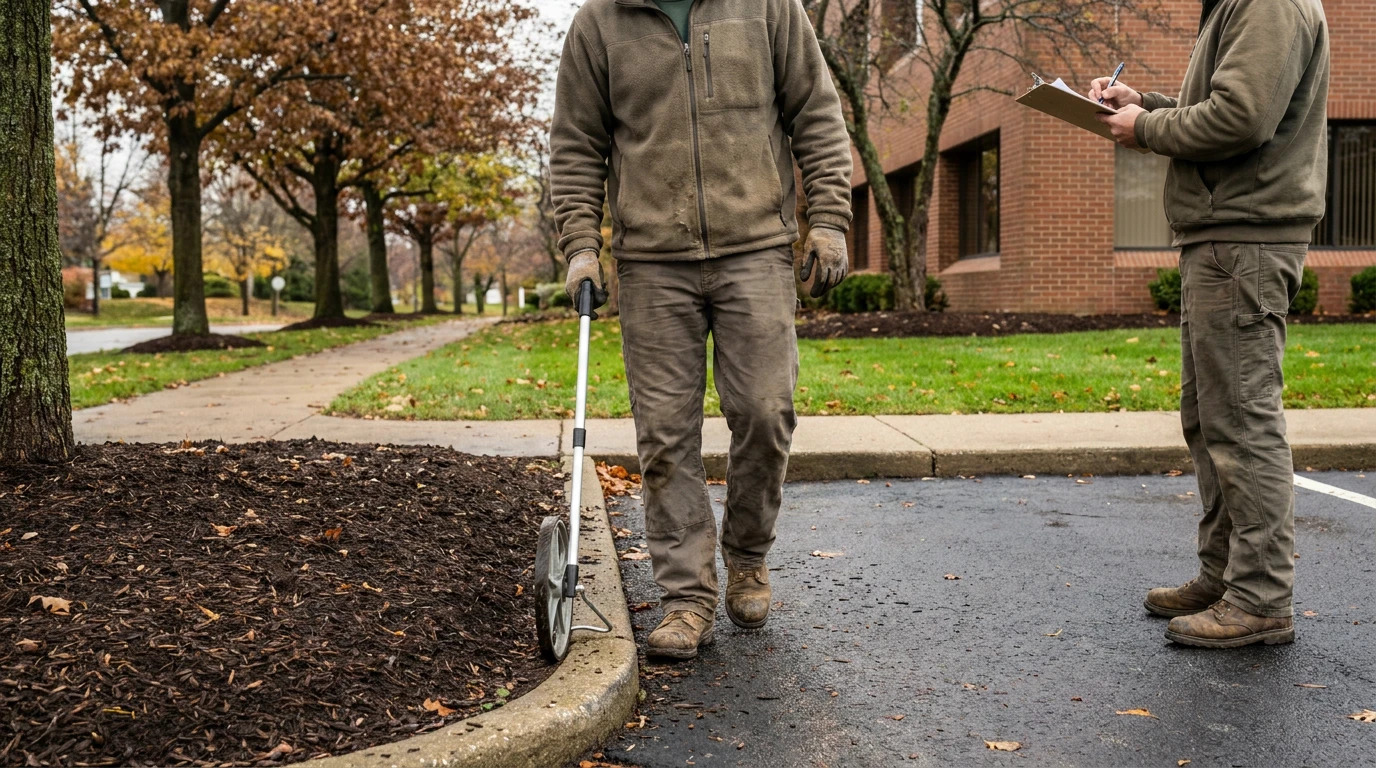
3. Measure First to Reduce Shortages and Leftovers
Ordering too little can mean another trip. Ordering too much can leave you moving, storing, or removing material the project never needed.
For mulch, use this volume calculation:
Cubic yards needed = area in square feet × added depth in inches ÷ 324
Clemson Cooperative Extension’s mulch guidance supports this estimating method.
For example:
- Bed area: 1,000 square feet.
- Planned added mulch depth: 2 inches.
- Calculation: 1,000 × 2 ÷ 324.
- Estimated volume: approximately 6.2 cubic yards.
That is a starting estimate before accounting for irregular areas or project-specific allowances. Check the mulch already in place before deciding how much additional depth is needed.
For soil and aggregate, confirm whether the project calls for loose or compacted depth. Ask the supplier about product-specific estimating considerations and weight conversions rather than using one assumption for every material.
Taking accurate measurements upfront helps prevent repeat trips, leftover materials, and unexpected costs that can eat into a project's profit.
4. Use Delivery When It Protects Productive Crew Time
Pickup can make sense for a small order, especially when a properly equipped truck is already traveling near the supply yard.
Delivery deserves a closer look when:
- The order would require several pickup trips.
- Your crew can continue useful work while materials are transported.
- The material exceeds your available safe hauling capacity.
- A truck or trailer is needed for another task.
- The jobsite has an appropriate unloading area.
Kurtz Bros. serves most of Northeast Ohio and lists delivery service up to six days a week during peak season. Its published per-trip maximums include:
- Mulch: up to 10 cubic yards.
- Soil: up to 8 cubic yards.
- Aggregate: up to 6 cubic yards or 8 tons.
The published minimum delivery quantity is 1 cubic yard. Confirm the applicable load limit, delivery availability, and fees for your specific order through the Kurtz Bros. delivery information.
Do not assume that a larger order is automatically more economical. Compare the delivery quote with the actual number of pickup trips and labor-hours it would replace.
For self-hauling, available bed or trailer space is not the same as safe carrying capacity. NHTSA explains that gross vehicle weight rating identifies the manufacturer-specified loaded vehicle weight. Check your vehicle and trailer ratings before planning a load.
5. Prepare the Drop Site Before the Material Arrives
Delivery can save travel time, but a poorly planned drop location can create extra handling.
Before scheduling, decide where the material can safely be unloaded and how the crew will move it to the installation area.
Check for:
- Firm, accessible unloading surfaces.
- Overhead wires, branches, and other obstructions.
- Adequate truck access.
- Space for the material pile to spread.
- A backup unloading location.
- Clear instructions if no one will be present.
Kurtz Bros.’ delivery conditions state that truck tires must remain on hard surfaces. Drivers do not enter yards to dump, spread material, or unload an order in multiple spots. Final unloading decisions remain with the driver.
Plan the work around those requirements. A convenient-looking drop point is not useful if the truck cannot safely reach it.
6. Build a Repeatable Ordering Process
For contractors managing several properties, small ordering habits can prevent repeated interruptions.
Keep a simple material record for each recurring job:
- Property name and delivery address.
- Approved product, color, or specification.
- Measured installation area.
- Previous order quantity and whether it was sufficient.
- Preferred pickup location.
- Delivery access notes.
- On-site contact and backup contact.
Before the next visit, update the measurements and confirm availability. Last season’s order is a helpful reference, not a substitute for checking current conditions.
This gives whoever places the order a clear starting point and reduces the chance of sending a crew out with incomplete instructions.
Where Can Northeast Ohio Contractors Order Landscape Supplies?
Kurtz Bros.’ landscape supply pickup locations include Akron, Avon, Broadview Heights, Garfield Heights, Hudson, North Canton, Strongsville, Valley View, and Willowick. Call or visit today an our experts will help you get a handle on all your landscape supply needs.
Use the Kurtz Bros. location directory to review locations before planning a trip.
Product availability can vary per location. Confirm current hours, product selection, quantities, and service options with the location handling your order.
A Better Supply Plan Starts Before the Crew Leaves
A local landscape supplier can help contractors save time and money when ordering is treated as part of project planning, not a last-minute errand.
It is always best to have the crew spend more of the day doing the work the customer hired them to do.
Ready to plan your next order? Visit Kurtz Bros. to check current pricing and explore pickup or delivery options for your location.
Frequently Asked Questions
Is pickup or delivery better for a landscape contractor?
Pickup can work well for small orders and convenient routes. Delivery may be more efficient when it replaces several trips, keeps employees working on-site, or avoids hauling-capacity limitations. Compare both options using your actual project needs.
How do I calculate how much mulch to order?
Multiply the area in square feet by the added mulch depth in inches, then divide by 324. For example, 1,000 square feet with 2 inches of added mulch requires approximately 6.2 cubic yards before project-specific allowances.
Does Kurtz Bros. deliver landscape supplies to contractors?
Yes. Kurtz Bros. delivers to commercial customers and homeowners throughout much of Northeast Ohio. Delivery availability, scheduling, fees, and load limits depend on the order and location, so confirm those details before scheduling your crew.